


|
MOUNTAIN BIKE SIZING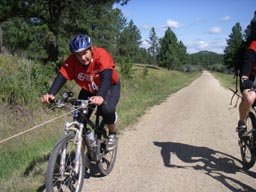
I learned early that mountain bike sizing is important. I've ridden a bike that was too big and that made it very hard to handle, not to mention painful when I fell...Yes I still fall a lot! I say: If your not falling your not pushing yourself...right? I used to ride a recreational bike and when I moved up to a racing bike it was wonderful. My racing bike was sized for me except I am a little spread out for adventure racing. It is a true racing bike and I'd like to sit up a bit straighter for adventure racing when we ride 100 miles on the trails. When I used to buy bikes we just measured how tall I was... boom picked out a bike in that size. The height is sill very important, but there is so much more to mountain bike sizing. From where your seat is adjusted, to your handle bar height there is a lot that goes into it. Below tells you just how to pick out the right sized bike for you. There will be basic steps, then it will get more specific. Getting on that perfect bike is worth the trouble of searching for that just right bike!
INSEAM AND PEDAL LENGTH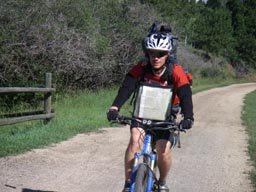
The distance between your inseam and your pedals, along with saddle tilt is one imperative measurement in this process of mountain bike sizing. That is the distance between your hips and the pedals, and if it is too long or too short it can be difficult to handle the bike. General Saddle Height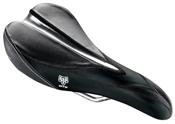 For your saddle height, sit on your saddle with one leg hanging free. Be sure your hips are square. This means both facing forward.
Your free hanging heel should touch the pedal with a straight leg. The pedal should be in line with your seat tube and at the bottom of its stroke. You want some bend in your knee. If your legs are straight it can create some discomfort on the saddle as your hips rock back and forth. Specific Saddle Height InstructionsTo get very specific follow these instructions. This adjustment should get you within 1 cm of where your seat needs to be. Lemond recommends lowering the seat by 3mm if you wear clipless pedals, though I do not do this. 1) Measure your inseam from as high as possible in the inseam to the floor. 2) Take that measurement and Multiply 88.3%. Or multiply your inseam length by .883. 3) Move your bike seat so the distance between the center of the the bottom bracket (this is where the crank attaches to the bike) to the low point of the top of your saddle is 88.3 percent of your inseam length, the measurement you just took. 4) While sitting on the adjusted seat put the ball of your foot over the center of the pedal spindle. Your leg should be at full extension with just a slight bend in the bottom of the pedal stroke. 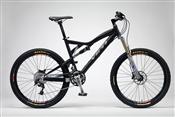
Pedals1) Sit on your bike on a trainer or with someone holding the bike for you. 2) Rotate your pedals parallel to the ground. Drop a plumb line from your bent knee to the ball of the foot (where your foot clips into the pedal). You can use a string with a pencil tied to the end for your plumb line. 3) You should adjust your seat until the plum line and the ball of the foot are in a straight line. This gives you an efficient pedal stroke. Saddle TiltYou want your pelvis to be on a level surface. Many people tilt their saddle forward as it is more comfortable. Stock saddles are usually very hard and it is better to replace the saddle with a comfortable one, in which you can ride at a level surface. The closer you get to level, the easier it will be to find the correct fore-aft saddle position. MOUNTAIN BIKE SIZING: FRAME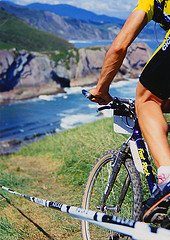
Step 1 Measure your inseam. You should do this barefoot. Stand against the wall and put a book between you legs so it presses right up against your pelvic bone. Make a mark with a pencil on the wall along the top of the book. Measure the distance from the floor to the mark in centimeters. Step 2 Use your inseam measurement to get a rough idea of your road bike size. Multiply your inseam by .65. This will give you a good estimate of your road bike size for bikes measured center to center. Thus if your inseam is 86 cm, you will fit a 56 cm road bike (86 x .65 = 55.9). Note that many road bikes are measured center to top. To determine how to fit these bikes, multiply your inseam by .67. 
Step 3 Subtract an additional 10cm and convert this measurement to inches to get your mountain bike frame size, roughly. If you fit a 56cm road bike (c-c), you will fit a 46cm - or an 18" - mountain bike. As a general guide, mountain bike sizes available are shown in the following table: Size XS Bike Size 14" - 15" Size S Bike Size 16" - 17" Size M Bike Size 18" - 19" Size L Bike Size 20" - 21" Size XL Bike Size 21" - 22"
MOUNTAIN BIKE SIZING CRANK LENGTH
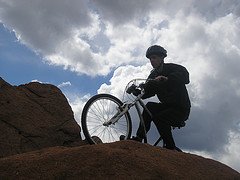
Crank length is important as it can cause knee problems if you have the wrong length. Chondromalacia is often a sign of the wrong crank length. The leg length will determine the crank length. It has been shown the correct length should be 18.5% of the distance from the top of your femur to the floor. The femur is your thigh bone and it attaches at the hip, which would be the top of your thigh. This is not a set in stone rule, but a general guideline. You also need to go by what gives you more power and comfort. Some say competitive cyclists should use shorter cranks to eliminate the deadspot while pedaling. The knee would then not bend less than 90 degrees. You can also have a faster pedal speak with a shorter crank, which can be beneficial for speed. For mountain biking it is said the longer cranks are better as you can apply more force. 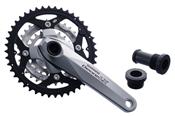
In endurance riding where you need more power and do not turn the pedals as fast, a longer crank is better. If you like a faster turnover go with shorter cranks, if you like to pedal slower and with more power go with a little longer crank. There are a lot of different charts for crank lengths as well as using the above formula. Here is one that is adjusted for mountain bike riding which is 5 mm longer than road bike cranks. * inseam < 29 inches - 170 mm crank * inseam 29 - 32 inches - 175 mm crank * inseam 32 - 34 inches - 177.5 mm crank * inseam > 34 inches - 180 mm crank
MOUNTAIN BIKE SIZING TUBE LENGTH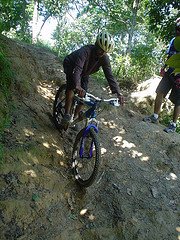
Consider top tube length very important. This is the tube that runs from the handlebars to the seat. Two 18" mountain bikes may have different length top tubes. Or a 54 cm and an 56 cm road bike may have the same length top tube. There are variances because of the angle of the top tube. Know that women have longer legs and shorter torsos than men. Most bikes are designed for men, and women often have a hard time finding a bike that will fit them well. Many manufacturers have begun to make women-specific models. Test ride some bikes once you have gotten a rough idea of what will fit you. This will help you determine what is most comfortable for you. Your best fit is where you can reach the bars with a slight bend in the elbows. You do not want a long reach or you'll be very uncomfortable, however you do not want to sit up as high as a cruiser bike either. Some where in the middle is perfect for mountain biking.
MOUNTAIN BIKE SIZING: FORE-AFT SADDLE POSITION
Your fore-aft position, or the distance your seat is from the handlebars, determines how you are balanced on your bike.This will affect your pedal efficiency. The distance between the seat and the bike handlebars is another important part of mountain bike sizing. The more appropriately sized the difference between the handlebars and the seat is, the better able you will be to handle your bike--especially during rough terrain. Too long of a distance to reach for the handlebars affects a rider’s ability to brake and shift and respond to rough or unsafe conditions.
MOUNTAIN BIKE SIZING: HANDLE BAR POSITION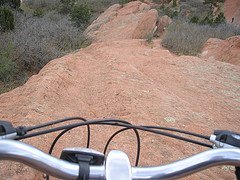
Having your handlebar forward and low, in a racing position, allows you better aerodynamics and high speed control. It is also harder on your body. If you do long rides, such as in adventure racing, this is not the position for you. If you choose to have the bar closer to you and higher it will be more comfortable. You will sacrifice efficiency. If you are riding for recreation, this is great and very comfortable. A very efficient position is to have your bars a couple of inches lower than your seat. This is going to be personal preference and how much efficiency you would like to have. Handlebar width is not as critical on a mountain bike as a road bike, where aerodynamics are key. The main thing here is to find a comfortable position for yourself.
Getting Help With Mountain Bike Sizing
If you go to a store to purchase your bike, the salesman there should be able to help you understand the importance of the different measurements for mountain biking sizing. Go to an actual bike shop, not a sporting goods store for a true mountain bike. In many cases, the distances can be altered to make you more safe and comfortable while atop the bike. Do you still need information on mountain bike sizing? Todd Molloy teaches you how to be sized for your bike. He also covers how and where to test your bike, and where to buy it from. This is a nice addition as you definitely want to get the "right" bike. How To Master Mountain Biking: Book
|
